How to choose the best occupational health software for multi‑site operations

Eight criteria, a checklist for vendor demos and an overview of eight products, each described in its vendor's own words. Written for employers running workforce health across sites, countries and contractors.

Buyer's guide · Lisa Bardet, VP Marketing · Updated November 5, 2026

The short answer

No occupational health software is best for every employer. An occupational medicine clinic that bills employers, an EHS team that needs a health module and a group running its own medical teams on remote sites need different products. In our view, for an employer with many sites and countries in a high-risk industry, eight criteria separate the products:

  1. 01One record per worker that follows them across sites and rotations, with contractors in the same record.
  2. 02Health surveillance scheduled from each worker's exposure group.
  3. 03Fitness-to-work decisions shared with HSE, HR and managers, without the medical details.
  4. 04Records kept, and retrievable, for as long as the rules require: decades for some records.
  5. 05Results straight from medical devices, and worker details straight from the HRIS.
  6. 06Health data hosted and processed under each country's privacy rules.
  7. 07Software that works for medics on remote sites, in their own language.
  8. 08Reporting across sites that never exposes one worker's medical details.

The vendor overview describes eight products in alphabetical order, in each vendor's own words, with the page we read and the date. Ask every vendor, us included, to show each criterion live in a demo.

What occupational health software does

Occupational health software manages the health of a workforce as an employer answers for it: who is exposed to what, which exams each worker needs and when, whether each worker is fit for their job, and what follow-up was decided. It keeps a health record per worker, schedules health surveillance and medical exams, records fitness-to-work decisions, manages cases and reports on all of it.

In a 2024 guidance statement, the American College of Occupational and Environmental Medicine (ACOEM) says occupational and environmental medicine clinicians need specialized electronic health records to address the privacy, data governance, interoperability and medical surveillance concerns specific to occupational health. It sets out 10 recommendations for these systems.

Occupational health software, EHS suites and clinical EHRs

Three kinds of software come up in the same searches. They overlap, but each is built around something different.

Occupational health software, EHS suites and clinical EHRs
Kind of softwareBuilt aroundExample scope
Occupational health softwareThe worker: exposures, surveillance, fitness-to-work and care, across sitesHealth record per worker, surveillance schedules, fitness-to-work decisions, case management
EHS suiteEnvironment, health and safety processes, with occupational health as one application in the suites we reviewedIncidents, hazards, chemicals, contractor safety, industrial hygiene, occupational health
Hospital or clinic EHRThe patient: their medical history, maintained by the provider over timeProgress notes, problems, medications, immunizations, lab data and radiology reports

In the two EHS suites we reviewed, occupational health is one application among several. Wolters Kluwer lists occupational health beside chemical management, contractor safety, incident management and industrial hygiene in Enablon. Intelex's product page describes occupational health and safety software as "a key component of a company-wide EHS program."

The Centers for Medicare & Medicaid Services (CMS) describes an electronic health record as an electronic version of a patient's medical history, maintained by the provider over time. In our view, an occupational health record has to add what a patient chart is not built around: exposures, surveillance schedules and fitness decisions, kept for each worker long after they leave. More in how hospital EHRs and occupational health records differ and on the occupational health EHR page.

Sources: ACOEM, Occupational electronic health records (2024)CMS, Electronic health records

Eight criteria for multi-site, high-risk employers

Each criterion says why it matters, then the questions to put to every vendor in a demo.

Criterion 1: One record per worker, across sites and contractors

Why it matters

Workers rotate between sites, change roles and come back years later. A record kept per site, or per employer of record, can split one person's history across systems. The gap shows when a health professional needs an earlier result, or when an auditor asks for one.

Criterion 2: Surveillance by exposure group

Why it matters

Health surveillance follows the hazard. In the US, specific federal OSHA standards, such as those for respirable crystalline silica and lead, require employers to make medical surveillance available to exposed workers, each with its own triggers, tests and schedule. State plans approved by OSHA must be at least as effective as federal OSHA. Grouping workers who share an exposure profile into a similar exposure group lets one rule set the exams for everyone in it.

Sources: OSHA 29 CFR 1910.1053 (silica)OSHA 29 CFR 1910.1025 (lead)OSHA state plans

Criterion 3: Fitness-to-work decisions without medical details

Why it matters

HSE, HR and line managers need to know whether a worker is fit for the job, with any restrictions. They do not need the diagnosis. In Great Britain, the Health and Safety Executive separates the health record, a legal record of the outcome of health surveillance kept by the employer, from medical records, which the occupational health professional keeps in medical confidence.

Sources: HSE, Health surveillance: record keeping

Criterion 4: Records kept for decades

Why it matters

Occupational health records outlive employment, and the period depends on the country and the exposure:

  • US: OSHA requires the medical records of workers exposed to toxic substances or harmful physical agents to be kept for at least the duration of employment plus 30 years, unless a specific standard sets a different period, with limited exceptions (29 CFR 1910.1020(d)(1)). Under the noise standard, for example, audiometric test records are kept for the duration of employment (29 CFR 1910.95(m)(3)(ii)).
  • Great Britain: a COSHH health record is kept for at least 40 years from the date of the last entry (COSHH regulation 11(3)).
  • EU: for carcinogens and mutagens, the list of exposed workers and their medical records are kept for at least 40 years after exposure ends, and for reprotoxic substances at least 5 years, in accordance with national law or practice (Directive 2004/37/EC, Article 15(1) and (1a)).

Sources: OSHA 29 CFR 1910.1020OSHA 29 CFR 1910.95COSHH 2002, regulation 11Directive 2004/37/EC

Criterion 5: Device and HR integrations

Why it matters

Surveillance produces device results. Under OSHA's noise standard, a baseline audiogram is due within 6 months of a worker's first exposure at or above the action level (1 year where mobile test vans are used), then a new audiogram at least annually, each compared with the baseline (29 CFR 1910.95(g)). Typing those results in by hand at every site adds a step where errors can creep in. On the HR side, people join, move and leave, and the health record should follow without double entry.

Sources: OSHA 29 CFR 1910.95

Criterion 6: Privacy and hosting by country

Why it matters

Under the GDPR, data concerning health is a special category: processing it is prohibited unless one of the conditions in Article 9(2) applies. Transfers of personal data to a third country or an international organization must meet the conditions of Chapter V (Article 44). Other countries set their own rules.

Sources: GDPR, Regulation (EU) 2016/679

Criterion 7: Remote sites and medics

Why it matters

Where care on offshore platforms, mine sites or vessels is delivered by a medic or nurse supervised by a doctor elsewhere, the software has to work for both: in the medic's language, with the supervising doctor able to review the case.

Criterion 8: Reporting across sites, without medical details

Why it matters

Headquarters needs comparable numbers: surveillance completed on time, fitness status, sick leave, work-related cases, by site and country. Those numbers are easier to compare when every site records the same way. And they have to be shown without exposing any one worker's medical details.

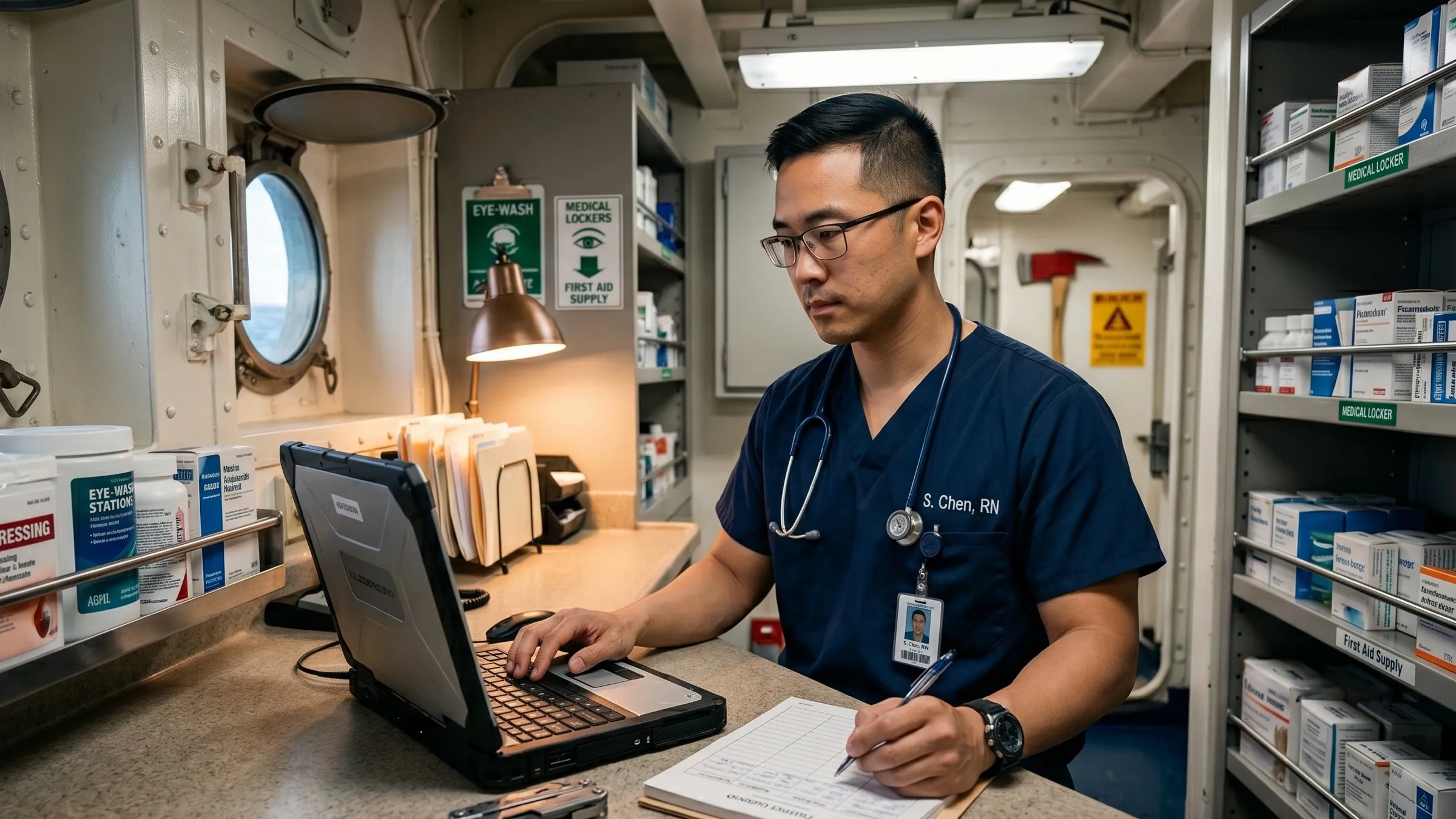
A nurse in a ship's medical room records a visit on a laptop.

Checklist for vendor demos

Run the same scripted scenarios with every vendor, on screen, with fictional workers. A slide is not evidence.

Checklist for vendor demos
No.Scenario to runWhat it shows
01A contractor moves from a site in one country to a site in another. Open their record at the new site.One record per worker, contractors included, across countries
02Assign a worker to a noise and silica exposure group. Show the exams that get scheduled and the alert when one is overdue.Surveillance by exposure group
03Record a "fit with restrictions" decision. Then log in as an HSE manager and as an HR partner.What each role sees
04Send an audiogram from a connected device and compare it with the worker's baseline.Device integration and baseline comparison
05Open the full record of a worker who left 10 years ago.Retention and retrieval
06Show the access log for one record: who opened it, when, in which role.Audit trail
07Change a worker's site and role in the HRIS. Show the change in the health record.HRIS sync
08Name where each country's health data is hosted and which subprocessors handle it.Hosting and privacy
09A medic on a remote site records a consultation in their own language and sends it to an onshore doctor for review.Remote care and supervision
10Build a report of overdue surveillance by site and exposure group, with no individual medical details.Reporting across sites
11Export one worker's complete record, as for a worker's request for a copy.Access rights

Also ask for references at a similar scale: number of sites, countries and languages. And ask for the migration plan for your current records: moving occupational health records off Excel and paper.

A worker in a hard hat and high-visibility vest guides a turbine rotor in a plant.

Occupational health software vendors: an overview

Products in alphabetical order. Each description quotes or closely summarizes the vendor's own product page, read on November 5, 2026. These are not ratings, rankings or endorsements: check current capabilities with each vendor.

Occupational health software vendors: an overview
Product (company, where different)What it is, in the vendor's wordsWho it is for, or how it is positioned, in the vendor's wordsSource, read November 5, 2026
CorityOccupational health software that "connects clinic management, surveillance, and case workflows in one platform", with clinic scheduling, employee health records, case management, medical surveillance, immunizations, injury and illness reporting, and telehealth.Organizations: the page says the software "helps organizations improve employee health outcomes." Cority lists separate solutions for third-party occupational health and for health workforces.cority.com
Cority MeddbaseCorityHealthcare management software that brings "employer contract management, clinical records, health surveillance, case management and billing into one system.""Private practices and occupational health providers."meddbase.com
EnablonWolters KluwerAn EHS platform with an occupational health application to "keep track of the medical history of workers while protecting the confidentiality and privacy of health records," plan visits and manage prescriptions and treatments."Large, complex organizations."wolterskluwer.com
Enterprise Health"One system to manage workforce health across every site, clinic and business unit," with encounter documentation, surveillance and program management, case management and restrictions, OSHA recordkeeping and HR system integration.Its "best fit" list includes 2,500+ employees, multiple locations or facilities, onsite clinics or structured employee health programs, and high regulatory and audit exposure.enterprisehealth.com
IntelexOccupational health and safety software that "streamlines the management of employee medical information," with employee health records for the whole workforce and visit types including surveillance and medical clearance.The page presents occupational health and safety software as "a key component of a company-wide EHS program."intelex.com
MyC Care"An occupational health and site care platform" that "brings consultations, surveillance, fitness to work and follow-up into one health record per worker, employees and contractors alike.""Companies working across sites and countries," and medical services providers.myc.care
OccuCareAn occupational health management solution with "centralized storage and tracking" and automated reminders when employees are due for physicals, vaccines and audiometric testing, plus health, wellness and safety modules and a mobile app.Occupational health professionals, in industries including chemicals, manufacturing, mining, oil and gas, pharmaceuticals and ports.occucare.co.in
PureOHSPureEHSSoftware that "gives employers a complete view of worker health by bringing together employee health records, medical surveillance, incidents, return-to-work programs, compliance activities, and reporting in one place." PureEHS also offers PureSYSTOC, "electronic medical record and practice management software designed for occupational health clinics."The page says it is "trusted by healthcare systems, manufacturers, and other organizations with complex workforce health and compliance requirements."pureehs.com

PureEHS is the former employee health and safety software business of UL Solutions, sold to an affiliate of Peak Rock Capital and rebranded; its products include PureOHS. Meddbase became part of Cority in 2025. In July 2025, Wolters Kluwer announced a global collaboration with Enterprise Health to deliver occupational health functionality to enterprises with on-site clinics. Product names are trademarks of their owners and are used here only to identify the products.

Compare one product at a time: Cority alternatives, Enterprise Health alternatives and PureOHS alternatives.

Where MyC Care fits

MyC Care is the workforce health platform for companies operating industrial and remote sites across countries, in energy, mining, manufacturing and maritime. Built by doctors, it brings occupational health and site care into one health record per worker: consultations, fitness-to-work, case management and exposures, kept for as long as the rules require, which for some records is decades.

Role-based access preserves medical confidentiality. Health professionals work in the full record. HSE, HR and management see only what their role needs, such as fitness status, restrictions and sick leave days without the medical reason, and follow live, anonymized trends to act before incidents happen. Every access is logged.

Trusted by Procter & Gamble, TotalEnergies and Eni: more than one million health records across 800 sites in 67 countries.

Explore the platform, or see how it works in energy, mining, manufacturing and maritime. Delivering care for clients? See MyC for medical services providers.

Book a demo

Against the eight criteria

One record per worker
Employees and contractors alike, across sites and rotations.
Surveillance
Scheduled per worker from their exposure group, with due dates and expiry alerts.
Fitness-to-work
The outcome is shared with HR, HSE and managers, while the medical basis stays confidential.
Retention
Medical details stay confidential, protected and recoverable for decades, to meet retention periods such as those set by OSHA and EU rules.
Integrations
Audiometers, spirometers, vision screening devices and EKGs send complete results to the worker's record. Hearing and lung function results can be compared with the worker's own baseline. Identity, site, role and contract type come from your HRIS, such as SAP or Workday.
Privacy
Medical details are encrypted at rest and in transit, and immutable backups protect stored copies. MyC is ISO 27001 and HDS certified, and compliant with GDPR and HIPAA.
Remote sites
Available in 15 languages, and an onshore doctor can review and approve a remote medic's actions.
Reporting
Surveillance completion and results by site, country or company, without personal medical details.

Questions

Still have questions?

Contact us
What is occupational health software?
Software that manages the health of a workforce as an employer answers for it: a health record per worker, health surveillance scheduled from exposures, medical exams, fitness-to-work decisions, case management and reporting. It differs from a hospital or clinic EHR, built around a patient's care, and from an EHS suite, where occupational health is one application beside safety and environmental processes.
What is the difference between occupational health software and EHS software?
EHS software manages environment, health and safety processes, such as incidents, hazards, chemicals and contractor safety. In our view, occupational health software is built around each worker's health record and the health professionals who keep it. Some EHS suites include an occupational health application, and some occupational health products include safety features. Whichever kind you choose, check how medical details are kept with health professionals and what each role sees.
Can we use our hospital or clinic EHR for occupational health?
A clinical EHR is built to hold a patient's care. Check whether it can also schedule surveillance by exposure group, record fitness-to-work decisions, share outcomes with HSE and HR without medical details, and keep each worker's record for decades after they leave. ACOEM's 2024 guidance statement says occupational clinicians need specialized EHRs for the privacy, data governance, interoperability and medical surveillance concerns specific to occupational health.
How long do occupational health records have to be kept?
It depends on the country and the exposure. In the US, OSHA requires the medical records of workers exposed to toxic substances or harmful physical agents to be kept for at least the duration of employment plus 30 years, unless a specific standard sets a different period, with limited exceptions. In Great Britain, COSHH health records are kept for at least 40 years from the date of the last entry. In the EU, records of workers exposed to carcinogens or mutagens are kept for at least 40 years after exposure ends.
Should contractors be in the same system as employees?
If they work on your sites under your health standard, one record per worker lets health professionals see earlier results and lets site teams check that everyone on site is cleared for the job, employee or not. Who legally keeps a contractor's records depends on the employment arrangement.
How do we move from spreadsheets or an older system?
Scope the migration first: which records, from which sites, in which formats. Older records can then be imported before each site switches on.

Better health starts with better health data

Help your teams deliver better care, identify health risks earlier, and focus prevention where it matters most.