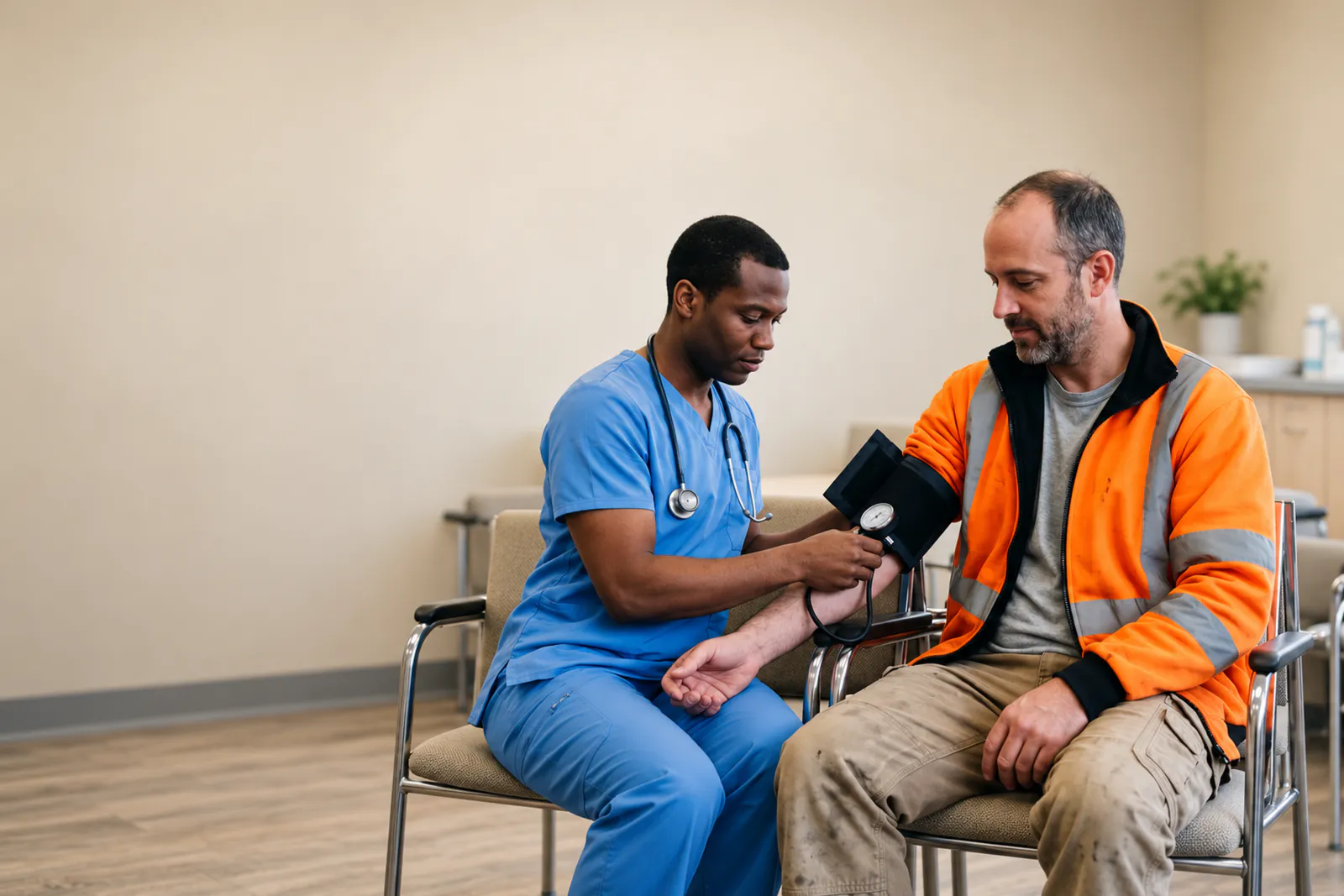
I have spent two decades practicing medicine on industrial and remote sites, some of them a flight away from the nearest hospital. In those settings, what I lacked most often was not equipment or skill but information. A worker arrived with a history that had stayed on another site, with another provider, and often that record was on paper.
MyC grew out of that experience. The platform was built with medical teams working in these conditions. This is why MyC had to be simple to use during a consultation, in their language, and match their processes.
I also learned that workforce health does not stop at the company gate. When a company raises the standard of care for its workers, it also raises it for the health system around them.
This paper is my attempt to set out what it takes to build such a system. I argue that a health policy can only be steered with data managed centrally, with one record per worker, and I endeavor to back each claim with a source. It is written for medical directors responsible for workforce health, and for the Health, Safety and Environment (HSE), Human Resources (HR) and executive teams they work with.
My thanks to Dr. James S. Allen, Dr. Alex Barbey, and all who contributed to this paper, and above all to the field teams who work around the clock to provide the best possible care. On the front line, they are the ones who collect the health information on which everything else depends.
A global health policy is a commitment a company makes to its workers: to protect and care for their physical and mental health, with the same access to prevention and care on every site. Safety policies have successfully reduced injuries. Now disease is the largest burden that employers face, as it causes 81% of work-related deaths (WHO/ILO, 2021).
In many companies though, health data is still compiled site by site, often with different tools and definitions on each site. Headquarters thus cannot easily see whether its standards are applied appropriately, and other functions cannot see the risks or aggregated impacts on the sites.
This paper makes the case for centralized health data. That is, one record per worker, kept in one system that every site uses, with access set by role along with aggregated analysis and reporting available at all levels. It covers what health data includes, what regulators require, how the data is governed and what each function gains from it. Data in itself is not the goal: such a system only protects workers if the company acts on what it shows.
Introduction
What is a global health policy?
A global health policy lays out how a company will protect and care for its workers’ physical and mental health. The policy gives every worker the same access to care and prevention, and aims to keep them able to work throughout their career. Medical teams, workers and their representatives, HSE, HR and executives should all be able to stand behind it. It follows the aim that the ILO and WHO set for occupational health in 1950: “the highest degree of physical, mental and social well-being of workers in all occupations” (Joint ILO/WHO Committee on Occupational Health).
Evidence and experience clearly show that safety policies have driven down the rate of injuries. In oil and gas, the fatal accident rate has fallen by more than 90% since 1985 (IOGP, 2024 data). Similarly, US private enterprises recorded 2.3 injuries and illnesses per 100 full-time workers in 2025, down from 5.0 in 2003 (BLS, 2025 data).
Diseases cause more deaths than injuries
Work-related deaths, worldwide
81%
disease
19%
injury
Work-related deaths, European Union
98.4%
work-related illness
1.6%
accidents
Sources: WHO/ILO joint estimates, 2021 (worldwide); European Commission (European Union).
The next challenge is disease, which now causes 81% of work-related deaths worldwide (WHO/ILO, 2021). Similarly, according to the European Commission, over 200,000 workers in the EU die each year from work-related illnesses, against over 3,300 fatal accidents at work in 2018 (European Commission, 2021).
Behind these numbers are workers whose health might have been better protected, or at least better managed, if a centralized record of their health and their exposures had been available. Unfortunately, many occupational diseases cannot be reversed once they appear. Work-related hearing loss, for example, is permanent, yet it can nearly always be prevented (NIOSH). Such prevention requires early detection, ongoing monitoring, a single medical record, and follow-up over a whole career. One longitudinal record that follows a worker across every site and provider makes this possible.
What centralized health data changes for care
For a group medical director, the case for centralized health data starts with care. One record per worker, in one system, improves it in three ways:
During the consultation. The clinician sees the worker’s full medical history, from every site and provider, and can take it into account in their own care recommendations.
In prevention. Early signals, such as restrictions piling up in one job or absences rising on one site, indicate where health professionals can act before a worker falls ill.
Over a career. Medical surveillance is planned from each worker’s actual exposure, in place of generic checkups, with the results compared with the worker’s own baseline. This ensures the care is tailored and relevant to the individual health record and exposures.
Health data today
In many companies, group medical directors steer health policy from reports that arrive once a month or once per quarter. Each site compiles its own figures, often with its own tools and definitions.
Yet a health policy cannot be steered without data. This data commonly includes fitness-to-work assessments, health surveillance and vaccinations. Headquarters set the standards and the data to be collected, but they need live, consistent and complete data from every site to help define them and monitor their application.
Preventing risk also requires collaboration across functions while preserving medical confidentiality and ensuring that individual health data stays within the medical team. Other stakeholders do not need individual records: they require the trends and indicators, such as absences rising on one site or abnormal hearing tests on one job function, to make informed decisions on risks and operations. A live view of key indicators, aggregated and anonymized across sites, lets HSE, HR, risk, and other executives identify risks and direct their own actions accordingly.
Workforce health metrics should reach the board too. Today, 83% of C-suite executives say that workforce well-being should be discussed at board level and 85% believe companies should be required to report these metrics publicly (Deloitte, 2023). Protecting workers’ health is a social responsibility and a matter of good governance.
The cost argument for a centralized system
A company cannot manage or reduce what it cannot measure. To know what ill health costs and its impacts, executives need aggregated data that is recorded the same way on every site. That data needs to show the cost by site, job and medical condition, both direct (medical care) and indirect (such as sick leave), and whether prevention brought it down.
Prevention of ill health and its impacts brings a positive return for companies. In an international study, prevention returned an estimated €2.20 for every euro spent (ISSA and DGUV, 2011). This matters more as medical costs rise and insurers project a further 10.3% increase worldwide for 2026 (WTW, 2026). These increases follow several years of double-digit growth.
Ill health also outweighs injuries on cost. In Great Britain, workplace ill health and injuries cost over £22 billion annually, with 72% of the annual costs coming from ill health, over 2.5 times the costs of workplace injuries (UK Health and Safety Executive, 2023/24).
Where does the £22.9 billion go?
Annual cost of workplace injury and new cases of work-related ill health, Great Britain
72%
ill health, £16.4bn, mostly unmeasured on site
28%
injury, £6.5bn, the part incident programs track
Figure 1. The cost of workplace ill health and injury in Great Britain. Source: UK Health and Safety Executive, 2023/24.
This paper makes the case for a data-driven health policy, which is only made possible by managing and having access to health data centrally. The paper covers what health data includes, why centralized data matters for companies, why it is fragmented today, proposed governance, cross-functional benefits and practical next steps.
What workforce health data covers
Work-related health data is usually understood as the confidential clinical record, which is why it has historically been kept in the hands of the medical teams. But a worker’s health data is much more than the clinical examination performed by a doctor or nurse.
The data includes records of all health-related activities during employment:
Occupational health: fitness-to-work assessments (before employment and at regular intervals), exposure history, surveillance history, sick leave, statutory reporting.
Health promotion, including prevention campaigns (smoking, obesity, cardiovascular risk, cancer, etc.) and vaccinations.
Primary health care delivered on site.
Case management: medical evacuation, referrals and outpatient care.
These elements are usually recorded by different teams or providers, which use different tools and log information in different places, which makes aggregation and analysis difficult, time-consuming, or both. Furthermore, a worker’s history is rarely available when another health professional needs it, or at the end of a career for assessing exposure and exposure risk.
Because health-related activities are so broad, personal medical information can end up circulating by email, unencrypted, and reach non-medical stakeholders such as HR and HSE. This can breach both medical confidentiality and data protection rules, resulting in regulatory and legal risks for both the company and its employees.
A central, shared system better protects medical confidentiality because access is based on each user’s role and is applied consistently across all types of health activity. There are three levels:
Health professionals see the clinical record.
HSE, HR, and the managers who organize the work see fitness-to-work outcomes and restrictions, without the medical reason.
Medical directors, HSE, HR, and executives see anonymized trends based on the dataset. Trends are only shown for groups large enough that no individual can be recognized.
One dataset, several readers
Anonymized, aggregated data
Sick leave
Fitness-to-work
Incidents
Exposure groups
Medical spend
→
HR
Sick-leave rate by site, rolling 12 months
Site A4.1%
Site B3.2%
Site C5.0%
By site and job, no names attached.
HSE
Fitness to work, all sites
Fit 86%
Fit with restriction 11%
Unfit 3%
7incidents this quarter
3overdue checkups
By site and exposure group, no names attached.
Finance
Cost of ill health, by driver
Sick leave46%
Medical spend31%
Incidents23%
Medical spend is only part of the cost.
Figure 2. Health data, read by each function according to its role.
Chapter 1
Why health data is key for companies
Health data is a company-level matter for three reasons: workers’ health care, well-being and prevention depend on it, it is subject to specific regulations, and it shows what ill health costs.
Protecting workers’ health
Data-driven health programs first benefit the workers. Studies show that general health checks offered to everyone have little or no effect on mortality (Krogsbøll et al., Cochrane, 2019).
What is better supported is health surveillance based on workers’ specific exposures, with results compared over time to the worker’s own baseline. For occupational asthma, workers under a surveillance program had symptoms for a shorter time and fewer hospital admissions than workers whose asthma came from other causes (Tarlo et al., Occupational and Environmental Medicine, 2002).
The following section shows how health data serves each of the three levels of prevention.
Compliance requirements for health data
Health data is subject to specific regulations, which are enforced by data protection authorities and workplace health and safety agencies. In the EU, it is a special category of personal data (GDPR, Art. 9) and a data breach must be reported to the authority within 72 hours (GDPR, Art. 33). Additionally, employees can ask for a copy of the health data held about them (GDPR, Art. 15) and the employer must be able to provide it.
In the US, HIPAA applies to health care providers and health plans, usually not to the health information employers hold about their own employees (HHS). Yet employers are required by the US workplace safety regulator OSHA to keep exposure records for decades (OSHA, 29 CFR 1910.1020).
Rules on how health data is handled
GDPR, Art. 9European Union: health data is a special category
EHDSEuropean Union: common requirements for health record systems from 2029
NEN 7510Netherlands: security standard care providers must follow
LGPD, Art. 11Brazil: health data is sensitive
HIPAAUnited States: healthcare providers and health plans
OSHA 1910.1020United States: medical records kept for employment plus 30 years
Figure 3. A selection of rules that apply to health data.
Working across countries means the following three questions need to be settled with legal and data protection teams specific to the jurisdiction:
Who controls the data: usually the local entity that employs the worker, and in some countries, such as the Netherlands, France, Italy and Spain, the occupational health service rather than the employer.
How it may cross borders: in the EU, a transfer outside the EU needs a legal basis such as an adequacy decision or the standard contractual clauses published by the European Commission (GDPR, Chapter V). Brazil works the same way, with clauses published by its own authority (LGPD, Art. 33).
A company thus needs to settle these points in each of the countries where it operates, before implementing a central system. Separating the two kinds of data helps: medical records stay under each country’s rules, while aggregated, anonymized indicators can be shared across the group.
The company is accountable for complete, accurate records
In the EU, large companies (with over 1,000 employees and over €450 million in turnover) must disclose their number of recordable cases of work-related ill health, not just injuries, along with the days lost to injuries and ill health (CSRD, ESRS S1-13). The figure must be published for the whole group, so the reporting is only as good as the records of every site.
In the US, regulators also investigate how health records are kept. In 2022, OSHA cited Amazon for 14 recordkeeping violations, including failing to record injuries and illnesses, misclassifying them and not providing records on time. OSHA announced the investigation and the citations against Amazon in a national news release (OSHA, 2022). Such publicity has a measured effect: one study found that an OSHA press release about a company’s violations led to 73% fewer violations at workplaces within about three miles, a deterrent effect equal to 210 inspections (Johnson, American Economic Review, 2020).
The deterrent weight of one press release
1 press release
=
210 inspections
73%
fewer violations at workplaces within about three miles, without being inspected
Figure 4. The deterrent effect of one press release. Source: Johnson, American Economic Review, 2020.
These company reporting obligations then reach the global medical directors, who are accountable for the group’s health figures. Having one central tool helps ensure that every site records cases in the same way, enabling the global medical director to meet their group-wide reporting obligations.
The company also remains legally responsible for its workers, even when external medical providers keep the records. OSHA requires the employer to make sure that exposure and medical records are preserved and accessible whether they are kept in-house or by a contracted provider (OSHA, 29 CFR 1910.1020(b)(3)). Thus the responsibility for what system is used and how records are kept ultimately resides with the employer.
The cost of ill health
Ill health has direct productivity and operational costs since sick leave means fewer people are available to work. In the EU, work-related illness and injury cost an estimated €476 billion a year, which represents 3.3% of GDP (EU-OSHA and ILO, 2017).
To spend prevention budgets where they will work and have measurable positive impact, a company first has to see where risk is building. That depends on the accuracy and completeness of its data. Yet in many companies, that data is not accessible and is scattered across sites and providers. The reason goes back to how occupational health has historically been organized.
Chapter 2
Health data is siloed by inheritance
Historically, health data stayed with medical teams for confidentiality reasons. It is some of the most private information a person shares in confidence with their doctors.
In our experience, most companies record medical information on sites with their own methods and tools: on paper, in spreadsheets and in software installed locally. Each site also often records in its own language and follows its own medical culture. There is usually no common standard for how health information is collected across the sites, and a worker’s record stays on the site where it was created.
This is why the reports sent by different sites may be inconsistent. One site may count a consultation per visit, and another per medical condition. One may include contractors in its headcount, and another not. Figures may be retyped from local files into a group spreadsheet, and each step can easily add a transcription or translation error. By the time they reach headquarters, the numbers are weeks, or sometimes months old, and are difficult to trace back to the records they came from.
Site by site, health records sit in paper files, spreadsheets, PDFs and emails, and headquarters can't compare them. In one global view, with one record per worker, the same sites read as one group overview.
Site by site
Per-site access.
Different formats and accuracy.
Site A
Paper records
Site B
Excel
On-site clinic
Paper records
Site C
PDF
Site D
Paper
Site E
Email
OH legacy softwareShared by 3 of 10 sites
HeadquartersCan't compare site data
One global view
Role-based access with audit trail.
Centralized data and analytics.
Group overview
10 sites · 7,960 employees
● Live
Surveillance up to date
94%
group average
Sick-leave rate
3.8%
rolling 12 months
Checkups due
212
next 30 days
Top reason
Musculoskeletal
31% of sick-leave days
Site
Employees
Surveillance up to date
Sick-leave rate
Top reason
Site A
1,248
96%
4.1%
Musculoskeletal
Site B
860
91%
3.2%
Respiratory
Site C
742
97%
5.0%
Mental health
Site D
610
89%
2.6%
Infectious
Site E
980
95%
3.9%
Musculoskeletal
Site F
1,105
93%
3.4%
Respiratory
Site G
540
88%
2.9%
Infectious
Site H
1,320
96%
4.4%
Musculoskeletal
On-site clinic
380
98%
2.1%
Respiratory
Offshore rig
175
92%
1.8%
Musculoskeletal
Figure 5. Drag the divider to compare the same sites, site by site and with one record per worker.
A common reporting template cannot fix this, because consistent reports require data collected in the same way at the source. Using a single tool, with a standard operating procedure, enables all health professionals to fill in the same data fields during the consultation and other medical activities.
Opting for a single tool also means that data access is defined centrally, and role-based access enables collaboration without breaching confidentiality. For example, HR can add a worker’s administrative information during a medical evacuation, without accessing the diagnosis. Health professionals, in turn, can log incidents and sick leave, which can be traced back to their source. This lets the medical team understand the medical reasons behind an incident or a leave.
Fragmentation rarely looks like a problem at the source, since each site may be fully compliant with local rules and conscientiously record data. The gaps, though, appear at group level. A missing entry at one site and a late one at another look minor on their own, but an auditor or a regulator will add them up. A company that holds its records in separate systems cannot confidently run for itself the check that an auditor will run.
Chapter 3
Health data governance
This paper shows that using health data beyond the clinic depends on the system that holds it. Before looking at implementation, the governance structure needs to be defined: who decides what, and who holds what. One workable split is:
Headquarters sets the protocols, the data definitions and the indicators.
The site physician or nurse holds the clinical record and owns medical decisions.
The data protection officer checks each country’s data protection rules, with local legal counsel where needed, and each local entity remains responsible for its own employees’ data.
Harmonization is necessary, but a global policy does not necessarily mean identical practice everywhere. Headquarters defines a common core, such as minimum standards of worker health, health care provision and prevention mechanisms, along with the definitions behind each indicator.
Each country then applies local regulatory requirements such as mandatory exams, their cadence, who may perform them, the status of the occupational physician, and where the data that results is hosted. Where local law or industry regulation requires more, it then applies. Where it requires less, the common core is the minimum. This ensures that a worker is protected to the same standard across the company, no matter where they may be located.
When site clinics are run by an external medical provider, the records should still be kept in the company’s system, in the agreed format, and meet at least the common core required by the company. For contractors, the company decides which health data it is responsible for, such as fitness to work on its sites, and which stays with the contractor’s employer.
Where there is no chief medical officer or global medical director, these standards still need an owner at group level. This is often a senior occupational health nurse or the HSE director working with an external medical advisor.
Three conditions for compliant use of health data
01Country rules metOne record per worker, processed under each country's data protection and security rules.
02Role-based accessPhysicians work in the full record. HR, HSE and executives see anonymized, aggregated data.
03A log of every accessEach view of a record is recorded, so the question of who saw what, and when, has an answer.
Figure 8. Three conditions for compliant use of health data.
Requirements for usable data
How and what health data is collected defines what can be learned from it. Simply put, if something is not recorded during the consultation, no later analysis can recover it. To obtain a consistent level of quality across sites, the system must set strict requirements for what to record and how to record it, including:
Structure: coded vocabularies, such as ICD-10, and constrained fields. Free text can now be analyzed with natural language processing (Khairuddin et al., PeerJ Computer Science, 2024), but only if it is written consistently.
Completeness: in primary care, completeness is critical to health outcomes and care delivery. In a study of US family doctor visits, clinically important information (lab results or letters from other doctors) was missing in 14% of visits and, in 44% of those, the doctor judged it could adversely affect the patient (Smith et al., JAMA, 2005). A worker seen on a new site, without their history, is in a similar situation.
Accuracy at source: each result goes through as few steps as possible, for example taken directly from the medical device that performed the test and ingested into the health system rather than retyped.
Consistency over time: workers are often followed for decades, so results must stay comparable over that period. Testing techniques and interpretation should not vary from site to site. When equipment is upgraded, the change should be recorded with the results, with a new baseline if needed, so that a difference between devices is not mistaken for a change in health (ACOEM, JOEM, 2020).
One global view
Group overview: 10 sites, 7,960 employees
94%
surveillance up to date, group average
3.8%
sick-leave rate, rolling 12 months
212
checkups due in the next 30 days
Site
Employees
Surveillance up to date
Sick-leave rate
Site A
1,248
96%
4.1%
Site B
860
91%
3.2%
Site C
742
97%
5.0%
Site D
610
89%
2.6%
Site E
980
95%
3.9%
Figure 9. One global view: every site read from the same records.
Chapter 4
Benefits of a centralized system, by role
01 / 06
Medical teams
Read each result against the worker's own history and exposure record, across every site and provider, and catch a decline early.
Expected result Better quality of care and health outcomes
Medical directors and CMOs
Steer and adjust global health policy from live indicators for every site, and see whether standards are applied and programs work.
Expected result Lower rates of work-related ill health and deaths, and improved workforce health baseline
Employees
Get better care, follow-up, and prevention, delivered consistently and based on their own health history and exposure record
Expected result Better care and prevention
HSE
See gaps against policy before they become incidents and identify trends from the aggregation of data to further improve prevention measures
Expected result Fewer incidents
HR
Investigate sick leave to address its reasons, across time and sites, and identify trends from the aggregation of data to further reduce sick leave.
Expected result Higher workforce availability and hence operational performance
Executives
View reports on health as a key performance indicator. Show regulators and courts a complete health and exposure record for the whole workforce.
Expected result Lower cost of ill health, lower legal and reputational risk
Medical teams: Better care through a longitudinal view
Any result is seen in the context of the worker’s history since hire, across transfers and medical providers. The clinician knows the worker’s past results, treatments, restrictions and exposures before deciding, without relying on what the worker remembers or repeating tests already done elsewhere.
Take spirometry. To detect a loss of lung function, a worker’s test results must be compared to their own baseline rather than to population norms. A decline of 15% or more from that baseline is a reason to refer (ACOEM, JOEM, 2020). Hearing works the same way: a standard threshold shift is an average change of 10 dB or more at 2,000, 3,000 and 4,000 Hz against the worker’s baseline audiogram (OSHA, 29 CFR 1910.95).
Reading a worker against their own baseline
Hire10 years20 years30 years
Lung functionOwn baseline15% below: refer
Figure 10. A worker’s lung function read against their own baseline. Source: ACOEM, JOEM, 2020.
Better care results from the follow-up that ensues. For instance, a worker should be referred as soon as their lung function is falling, while their results are still in the normal range, and their exposure should be promptly reviewed. A worker with a threshold shift should have their hearing protection refitted and be retrained in its use, as required by OSHA in the US. Without the baseline, both workers would show values within the normal range, neither would be treated, and the damage would continue.
Continuity of care also changes the outcome. One example of this is a nationwide Danish cohort, which compared patients who had fewer than 25% of their contacts with their usual provider and patients with full continuity. The first group had a mortality rate 2.6 times higher, and 49% more potentially inappropriate medication (Prior et al., BMC Medicine, 2023). In a company, workers change sites and providers, so a shared record is what preserves continuity of information when the provider changes.
Medical directors and CMOs: A global health policy, steered from data
Instead of consolidating site reports at a set cadence, the medical director reads the same indicators directly from the records, on any day and for every site.
A global health policy then comes down to a few minimum standards applied everywhere (such as fitness-to-work criteria, health surveillance by exposure risk and job role, required vaccinations) and four indicators to monitor them:
Program coverage by site: the share of workers due for a fitness-to-work exam, a surveillance test or a vaccination who had it on time, per program, over the last 12 months
Health-related incidents: incidents where the investigation found a health cause, such as fatigue, a medical condition or a restriction not applied, per million hours worked
Workforce availability: days lost to work-related injuries and ill health per worker per year
Cost of ill health: medical spend, sick leave and replacement per worker per year, in one figure
Two of the four follow established reporting. Days lost to work-related injuries and ill health are disclosed under the CSRD. Program coverage is close to the leading health indicators that IOGP and Ipieca collect from their member companies (IOGP-Ipieca, Health performance indicators). Health-related incidents and cost of ill health are proposed here and have no standard definition yet.
Employees: Better prevention, care and follow-up
For employees, having a single health record means better care and prevention that starts earlier. Fitness-to-work exams, surveillance tests and vaccinations are planned from their own history and situation, not left to each site. When they move to another site, their follow-up moves with them.
Every physician who sees them decides on the basis of their full history, rather than part of it. They no longer have to repeat the same information at each consultation. Their confidentiality is protected by how the system is built, and they can access part of their own record directly. In a US study, most patients who could read their doctors’ notes reported feeling more in control of their care (Delbanco et al., Annals of Internal Medicine, 2012). This supports trust in the health service provided by the employer.
Trust matters for care, because a physician can only act on what the worker tells them. A worker who fears for their job may hide a symptom, a medication or a condition until it becomes an incident. In a UK survey, 41% of workers said they would not feel confident discussing a health issue with their employer, many for fear of how it would affect their job (Benenden Health, 2021).
One record that follows the worker
HireSite A
TransferSite B
TodaySite C
Figure 11. One record that follows the worker.
HSE: Fewer incidents, with prevention aimed at the gaps
Unfortunately, fitness restrictions do not always reach managers and thus an incident may start from a restriction that the physician had set, but that the people organizing the work could not see.
When health data is appropriately aggregated and anonymized across sites, HSE can see the gaps against its own policies and procedures. For example, HSE can identify cardiovascular risk factors in roles with heavy physical load, reduced lung function among workers exposed to dust or fumes, and hearing loss in high-noise areas. Closing these gaps is associated with fewer incidents.
In a US trucking company that screened drivers for sleep apnea, those who did not follow treatment had about five times the rate of serious preventable crashes, while those who did had the same rate as other drivers (Burks et al., Sleep, 2016). Hearing shows the same link: among workers exposed to high noise, those with severe hearing loss were about three times more likely to have repeated accidents (Girard et al., Occupational and Environmental Medicine, 2009). A program that identifies hearing loss early allows these workers to be protected before an accident happens.
Where the workforce stands against policy
Indicator
Site A
Site B
Site C
Cardiovascular risk factors roles with heavy physical load
Within policy
Gap
Within policy
Reduced lung function dust and fume exposure groups
Gap
Within policy
Within policy
Hearing loss high-noise areas
Within policy
Within policy
Gap
Figure 12. Aggregated, anonymized view by site.
A centralized system with role-based access enables those with expertise in HSE and incident prevention to identify the gaps to focus on, while always ensuring the medical confidentiality of the workforce is protected. From a company perspective, such a system also provides a log of when and what was seen by whom, and can be used as a proactive management tool for those leading HSE teams.
Who saw what, and when
Role
View
Logged
Site physician
Full record
Yes
Chief medical officer
Coverage by site
Yes
HSE lead
Anonymized trends
Yes
Figure 13. Every access recorded, by role.
HR: Higher workforce availability
In a large study of young employees, those with frequent short absences in their first year of full-time work had a higher risk of long-term sickness absence over the following two years (Sørensen et al., BMJ Public Health, 2025). Another study shows that frequent short absences also predict later long absences for mental health reasons (Sumanen et al., BMC Public Health, 2017).
With a centralized system, HR gets direct access to sick leave trends by site and group of employees and can investigate the reasons with the medical team to better understand the context, without ever accessing individual diagnoses. This enables the teams to detect patterns early and act quickly, so that absence is addressed before it becomes long term, which supports both better care for the employee and higher workforce availability for the company.
Sick leave is not counted or reported the same way in every country. The system should therefore show trends both across the company and within each country, so that sites are compared on a like-for-like basis and local reporting requirements are met.
First year of full-time work
Frequent short absences
→
Following two years
Higher risk of long-term sickness absence
Figure 14. An early signal in routine sick leave data. Source: Sørensen et al., BMJ Public Health, 2025.
Mental health is taking a growing share of work-related ill health, and the absences it causes last far longer than others. In Australia, mental health conditions made up 12.2% of serious workers’ compensation claims in 2024/25, up 169% since 2014/15. Looking at 2023/24, the median mental health claim meant 34.8 weeks off work for an employee, against 8.2 weeks across all serious claims (Safe Work Australia, 2026). Employers in Australia must now manage psychosocial risks like any other workplace hazard (WHS Regulations 2011, regs. 55A to 55D). Similar duties apply elsewhere: in the EU and the UK, employers must assess all risks to workers’ health, psychosocial ones included (Directive 89/391/EEC, Art. 6; Management of Health and Safety at Work Regulations 1999, reg. 3). Mexico (NOM-035-STPS-2018) and Japan (Stress Check Program, 2015) have specific rules.
Executives: Health reported alongside the rest of the business
Health indicators can be managed centrally, in the same way as financial data. Executives can review the same four indicators as the medical director (program coverage, health-related incidents, workforce availability and cost of ill health) and ask the medical team for context. The goal is always to act early on signals, before they damage workforce health and business performance.
In addition to lowering medical costs, better workforce health could generate an estimated $3.7 trillion to $11.7 trillion in global economic value, 4% to 12% of global GDP (World Economic Forum and McKinsey Health Institute, 2025). Capturing these gains takes more than improving individual care for each worker and extends into changing the work itself, which the next chapter covers.
Global economic value of better workforce health
$3.7 to $11.7 trillion
$0$3T$6T$9T$12T
4% to 12%
of global GDP
54% to 77%
of that value coming from productivity
Figure 15. The economic value of better employee health. Source: World Economic Forum and McKinsey Health Institute, 2025.
Chapter 5
From data to action
The value of the data always depends on the actions that follow. Better follow-up of each worker is not enough, and lasting prevention requires changing the conditions and the organization of work.
When every activity is recorded the same way on every site, the data can do more than feed reports: it can show early risks, such as:
Sick leave recurring in the same crew
Repeated consultations for the same symptoms on one site
Fitness-to-work restrictions piling up in one job position
The medical team can then look for the cause, and the company can act through cross-functional collaboration.
In practice and ideally, this is a virtuous circle. The data shows a signal, the medical team interprets it, HSE and operations change the work and then the same indicators show whether the change had an effect.
This loop however is rarely how things work today. In many companies, health stays the medical team’s business, HSE focuses on incidents, and a rise in sick leave is handled by HR one worker at a time. Making the loop work virtuously supports a change in culture whereby the system enables all functions to look at the same data, understand the interpretations collectively and then act on them collegially.
Chapter 6
First steps toward a centralized health system
Moving to one record per worker is a project, not a switch. It starts with understanding how things work today: how each site records health data and with which tools, which processes surround health, from pre-employment checkups to sick leave, which rules and certifications apply in each country, and who keeps which records.
Companies often start with one region or one program, for instance one surveillance program. We recommend planning around six parameters:
Security. Health data is among the most sensitive data a company holds. Before any record is moved, the company should decide where the data is hosted, who can access what, and which certifications the system must hold, such as ISO 27001, HIPAA in the US, or HDS in France.
Storage. Records that must be kept for 30 to 40 years cannot be dropped. Active records can be moved into the new system, and older paper files scanned and indexed so they can still be found.
People. Site doctors, nurses and medics need to be trained on a system that follows their clinical workflow, in their language, with templates adapted to local practice.
Exporting information. Because records must outlive any contract, the company should be able to export them in a standard format at any time.
Roles and responsibilities. Medical teams, the data protection officer, IT and, where the law requires it, employee representatives should be involved from the start.
Alignment. A shared system changes who looks at health data. Before launch, medical teams, HSE, HR and management should agree on what the data is for, who reviews it, and how often.
The conditions described in this paper are rarely met all at once, and progress is gradual. The three levels below map where companies stand and what to work on next.
Making progress: Maturity levels
Based on discussions with hundreds of companies, across industries and countries, MyC developed a Health Maturity framework to help leaders review the current health data setup and get practical next steps.
Emerging: health information and practices depend on individuals, local routines or scattered records. Start with a shared process and a consistent way to record information.
Structured: repeatable processes and maintained records support your health program, but coordination or oversight still depends on manual work. This is where a central system brings the quickest gains for shared visibility and consistent follow-up.
Governed: centralized data, clear responsibilities, and regular reviews already support decisions across sites. Sustain these practices and measure how improvements lead to better outcomes.
The first level matches the situation described in chapter 2: records that depend on each doctor and each site. The second level is where data quality at entry starts to hold. The third is where health data is used across sites, and where prevention can be aimed at the risks that data shows.
In practice, moving up requires setting common definitions, implementing one health record per worker, and reviewing the indicators regularly with HSE, HR and executives.
Conclusion
Disease, not injury, now accounts for most work-related deaths. A health policy that addresses it cannot be steered from reports compiled site by site, with different definitions. Nor can the company show regulators what it does, or know what ill health costs.
One record per worker, kept in one system and read according to role, changes that. Care improves in three ways: in the consultation, where the clinician sees the full history; in prevention, where early signals show where to act; and over a career, where surveillance follows each worker’s exposure.
The system does not work by itself. It requires headquarters to set a common core and each country to apply it within its own law. In a similar manner, the medical team, HSE, HR and executives should collaborate based on the same indicators.
Data is not the goal, but it is a requirement to identify the risks. The company should then act promptly, through medical care but also by improving working conditions and the organization of work. Business performance benefits in turn. No company gets there in one step. Most start with one region or one program, and build from there.
At that point, health data stops being a record of what has already happened to workers. It becomes a way to change what happens next.
About the author
Dr. Laurent Bonnardot is the founder and CEO of MyC. He is an ear, nose and throat (ENT) and emergency physician with two decades of practice in remote and industrial environments, from Antarctica to Africa and the Middle East.
In the field, Laurent saw that when workforce health was managed proactively on the basis of accurate data; care, safety and operational performance all improved. He also learned that no tool succeeds on technology alone: each profession has its own culture, habits and language, and a solution that ignores them goes unused.
Medicine is a collegial practice, where doctors depend on each other’s expertise. In 2009, Laurent co-founded Collegium Telemedicus (Wootton and Bonnardot, Frontiers in Public Health, 2019), a nonprofit tele-expertise network through which field doctors have received specialist advice on more than 100,000 cases in remote and low-resource settings.
During the COVID-19 pandemic, Laurent led the response for a global energy company in Angola, where about 2,000 workers a month passed through Luanda on their way to offshore platforms. The medical team needed to know every day, across every site, who was sick and who had been exposed, and operations needed to know who was fit to work. Laurent found that there was no reliable way to track and report it.
In 2020, that collective experience became MyC. The platform is built for collegial work: doctors, nurses, occupational health teams and operations each work in their own way, but share the same information and work together for the benefit of the employees and company operations. It follows the clinical workflow, so health professionals can start using it after 30 minutes of training. What they record is structured the same way on every site, which gives headquarters consistent indicators to steer one health policy.
About MyC
MyC is a workforce health platform for organizations looking to improve care, prevention, and health outcomes. It gives each worker a single health record, with full access for medical teams and live, aggregated trends for HSE, HR and executives.
MyC is ISO 27001 and HDS certified, and compliant with GDPR and HIPAA. Global companies such as TotalEnergies, Subsea7, and International SOS use it to manage more than one million health records across 800 sites in 67 countries.
Glossary
Baseline: a worker’s first test result, against which later results are compared.
Case management: coordinating a worker’s care for an illness or injury, from referral or medical evacuation to return to work.
CMO: chief medical officer, the physician responsible for health policy at group level.
CSRD and ESRS: the EU Corporate Sustainability Reporting Directive and its European Sustainability Reporting Standards, which set what large companies publish on their workforce, including health and safety.
EHDS: the European Health Data Space regulation, which sets common rules for electronic health record systems.
Fitness to work: a physician’s decision on whether a worker can safely do a given job, with or without restrictions.
GDPR: the EU General Data Protection Regulation, which sets the rules for processing personal data, including health data.
Health surveillance: medical follow-up of workers exposed to a given hazard, such as noise, dust or chemicals, to detect early effects on their health.
HDS: Hébergeur de Données de Santé, the French certification required to host personal health data.
HIPAA: the US Health Insurance Portability and Accountability Act, which protects health information held by health care providers and health plans.
HR: human resources.
HSE: health, safety and environment, the function in charge of workplace safety.
ICD-10: the World Health Organization’s international classification of diseases, used to code diagnoses.
ISO 27001: the international standard for information security management.
LGPD: Lei Geral de Proteção de Dados, Brazil’s general data protection law.
Longitudinal record: one record that follows a worker over time, across sites and jobs.
NEN 7510: the Dutch information security standard for health care.
OH: occupational health.
OSHA: the US Occupational Safety and Health Administration, the federal workplace safety regulator.
Primary, secondary and tertiary prevention: removing a risk at its source, detecting its early effects on workers, and limiting the consequences once a worker is ill or injured.
Psychosocial risks: aspects of how work is designed, organized and managed, such as workload, working hours, isolation or harassment, that can harm mental or physical health.
Recordable case: a work-related injury or illness that must be entered in the company’s official log, as defined by regulators such as OSHA.
Spirometry: a breathing test that measures lung function.
Standard threshold shift: a drop in a worker’s hearing, measured against their own baseline, that OSHA requires employers to act on.
Tell us about your sites and your health program, and we will share tailored recommendations.
By submitting this form, you consent to MyC contacting you about its products, services and events. You can unsubscribe at any time. For more information, see our Privacy Policy.
The form is taking longer than expected. Please email us.
Request sent
Thanks for reaching out. Our team will get back to you shortly.