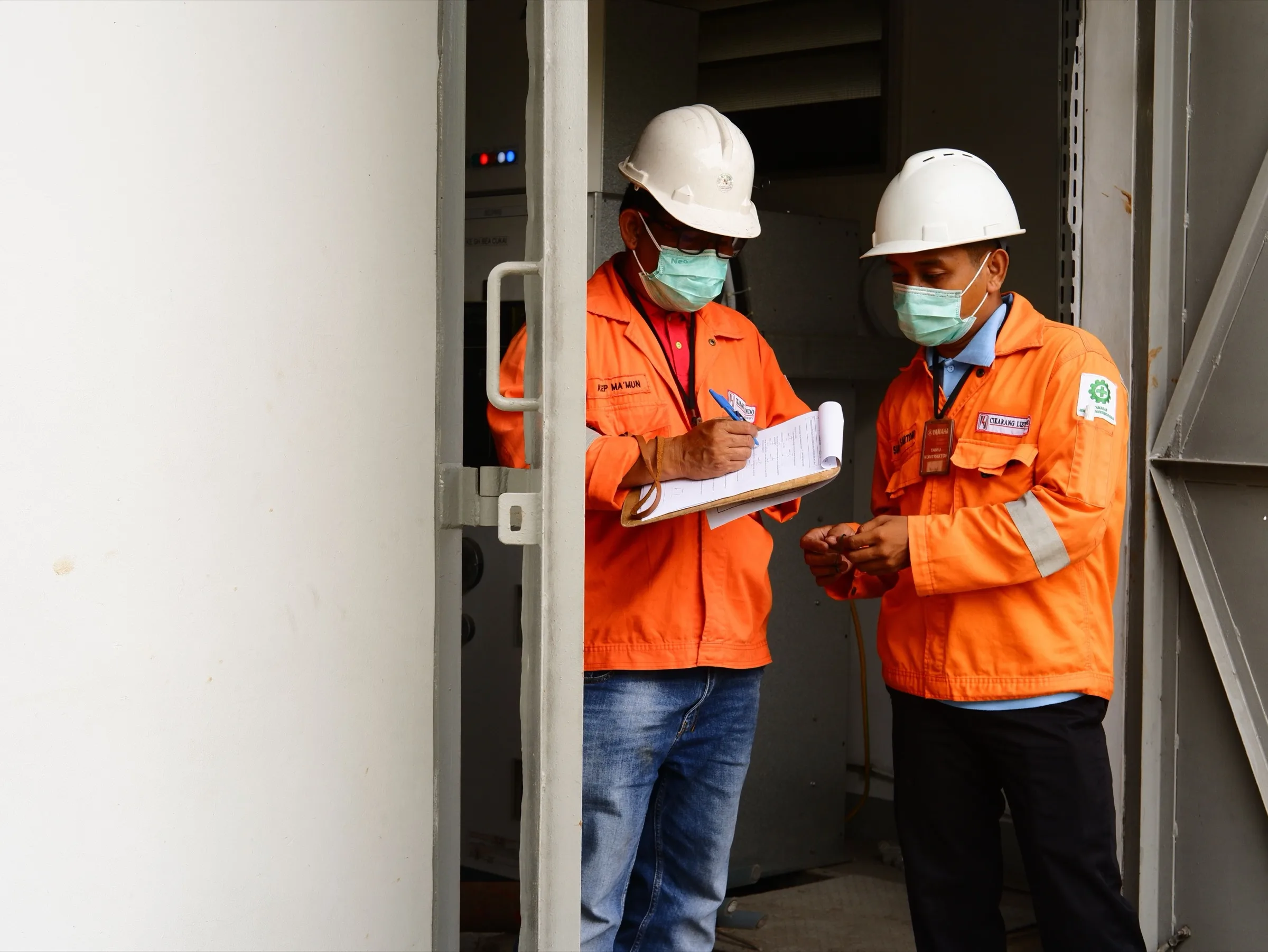
Contractor health records are kept by whichever employer the law, or the contract, makes responsible for the worker’s health surveillance, and that answer changes by country. In the US, OSHA treats a staffing agency and its client as, typically, joint employers of temporary workers, and its guidance asks them to agree before work starts who runs surveillance and keeps the records. In Great Britain, the COSHH health surveillance duty stays with the worker’s own employer. Across the EU, employers who share a workplace must cooperate on prevention.
This is general information, not legal advice for a specific site.
Why contractor health records go missing
Take a fictional welder employed by a maintenance contractor. In one year she works a refinery turnaround, then an offshore rotation for another operator. Her employer sends her to a clinic for a respirator medical evaluation, the refinery’s occupational health team tests her hearing, and the platform medic treats a skin irritation. Three files now exist in three places, and nobody can compare her hearing with her baseline.
The gap appears because each party assumes another keeps the history.

In the US, OSHA treats agency and host as joint employers
OSHA’s Temporary Worker Initiative describes a staffing agency and its client, the host employer, as typically joint employers of temporary workers, with both responsible for working conditions and compliance. Its bulletins are guidance: OSHA states that they create no new legal obligations (TWI Bulletin 1). The binding duties come from the standards they explain, and states with OSHA-approved State Plans may set different or additional requirements.
These bulletins address staffing-agency workers. A contractor that directs its own employees is their employer, and the access standard applies to the records it makes or contracts for.
The injury log follows supervision
For the OSHA 300 log, 29 CFR 1904.31 is explicit. An employer records the injuries and illnesses of workers off its payroll, including temporary and leased workers, if it supervises them day to day. When a contractor supervises its own employee day to day, the contractor is responsible for recording the case. Each case goes on one log only, and the employers should coordinate to ensure it.
Medical surveillance records are agreed in advance
OSHA’s bulletin on respiratory protection says the host usually has primary responsibility for the respiratory protection program. The same bulletin notes that medical evaluation questionnaires and exam results are medical records under the access standard, and says joint employers must agree who will keep them before work begins, though OSHA’s bulletins create no new legal obligations. It lists three options:
- the employer that provides the evaluation keeps them in a confidential file;
- the physician or other licensed health care professional who did the evaluation keeps them on the employer’s behalf;
- the employer’s medical office keeps them, if it is administratively separate from central administration.
The hearing conservation bulletin notes that the general industry noise standard (29 CFR 1910.95) requires a baseline audiogram within 6 months of a worker’s first exposure at or above the action level, or within one year when a mobile test van is used. Where temporary workers move between hosts for less than a year and could be missed by each host’s testing, OSHA says the staffing agency may be better placed to provide baseline and annual audiograms. The employers should settle who handles each part before work starts, preferably in writing, and neither can avoid its responsibility by requiring the other to do the work. For the rest of the program, see our hearing conservation program guide.
The access standard covers records made by contract
29 CFR 1910.1020 applies to employers who make, maintain, contract for or have access to exposure or medical records pertaining to employees exposed to toxic substances or harmful physical agents. Paragraph (b)(3) covers records made in-house or on a contractual, fee-for-service basis, so outsourcing the clinic does not outsource the duty. Medical records are kept for the duration of employment plus 30 years. The records of a worker employed for less than one year need not be kept after employment ends if they are given to the worker on leaving. Our guides to OSHA employee medical records and how long to keep occupational health records cover retention in detail.
Agencies sometimes refuse to share medical details with the host for the log, citing HIPAA. In a 2018 interpretation, OSHA explained that the HIPAA privacy rule binds an agency only if it is a covered entity, and that HIPAA permits a covered entity to disclose health information for Part 1904 recording.
In Great Britain, COSHH keeps surveillance with the worker’s employer
The Control of Substances Hazardous to Health Regulations 2002 (COSHH) apply in Great Britain; Northern Ireland has its own 2003 equivalent. Regulation 3 extends most employer duties, so far as reasonably practicable, to other people who may be affected by the work, such as contractors on site. Health surveillance is the exception: the regulation 11 duty does not extend to people who are not the employer’s employees. A relevant self-employed person is treated as both employer and employee under COSHH, but regulations 10 and 11 do not apply to them.
So the business that employs the worker owes the health surveillance: the contractor, or for agency staff the employment business or, where an agency only introduced the worker, the end user (HSE definitions). Under regulation 11, that employer keeps a health record for at least 40 years from the last entry, gives the worker access to it on reasonable notice, and, if it ceases to trade, notifies HSE in writing and makes its health records available to HSE.
HSE’s record-keeping guidance separates two documents. The health record holds the worker’s details, where they work, the hazards they are exposed to and whether they remain fit to work with them. Clinical notes and test results go in the medical record, held in confidence by the occupational health professional; the employer sees it only with the worker’s written consent. HSE calls it good practice to offer workers a copy of their health record when they leave, and says medical records should move with a change of occupational health provider.
The host still has duties. Under the Management of Health and Safety at Work Regulations 1999, regulation 11, employers sharing a workplace must cooperate, coordinate their measures and inform each other of risks. HSE’s leaflet Using contractors asks clients to cover risks to contractors, including health risks, in their risk assessment and to agree controls before work starts. For agency workers, HSE’s guidance on suppliers and end users gives the end user day-to-day responsibility and has the supplier confirm the controls in place, including health surveillance.
In the EU, employers sharing a workplace must cooperate
The framework Directive 89/391/EEC sets a baseline that member states transpose. Article 6(4) requires employers whose undertakings share a workplace to cooperate on health and safety, coordinate their prevention measures and inform one another and their workers of the risks. Articles 10(2) and 12(2) require the host to inform the employers of outside workers about the risks and to ensure those workers have received appropriate instructions. Article 14 leaves health surveillance to national law and practice, with each worker able to receive surveillance at regular intervals if they wish.
For fixed-term and temporary agency workers, Directive 91/383/EEC adds specific rules. Member states that do not bar these workers from work needing special medical surveillance, as national law defines it, must ensure they receive appropriate special medical surveillance, and may provide that it continues after the employment relationship ends (Article 5). During an agency assignment, the user undertaking is responsible for the conditions of the work as they relate to safety and health, without prejudice to the responsibility of the temporary employment business (Article 8).
Who does what: a summary by jurisdiction
| Question | US (OSHA) | Great Britain (COSHH, MHSWR) | EU (89/391/EEC, 91/383/EEC) |
|---|---|---|---|
| Who runs health surveillance? | Shared by agency and host for temporary workers; OSHA recommends dividing tasks before work starts | The worker’s own employer (usually the contractor; for agency workers, see who is the legal employer) | Set by national law (89/391 Art. 14; 91/383 Art. 5 for work needing special medical surveillance) |
| Who keeps the medical records? | Temporary workers: agreed between agency and host. Other contractors: the contractor as employer. | Health record by the employer; medical record by the occupational health professional | Set by national law |
| What the host must do | Usually runs site programs, such as respirator and hearing programs, and coordinates with the agency | Cooperate, coordinate, inform; assess risks to contractors | Cooperate, coordinate, inform outside employers; for agency workers, the user undertaking answers for safety and health conditions, without prejudice to the responsibility of the temporary employment business |
| Retention | Employment plus 30 years, with the under-one-year exception | At least 40 years from the last entry for COSHH health records | Set by national law |
Two operating models: host-run or contractor-run surveillance
Host-run. The host’s occupational health service examines everyone exposed on site, employee or not. Coverage is consistent, but the host must agree with each contractor who holds the record.
Contractor-run. Each contractor or agency runs surveillance for its own workers and shares outcomes. The host must check that the program matches the site’s exposures.
Either way, keep clinical details with health professionals and share only the outcome, such as fit, fit with restrictions or unfit.
What to put in the contract
Write the split of duties down before mobilization:
- Exposure groups on the site and the surveillance each requires locally.
- Who runs each exam: pre-placement, baseline, periodic and exit.
- Who keeps the medical record and who keeps the fitness outcome.
- Retention that meets the strictest applicable rule, and what happens to records when the contract ends.
- What the host receives: fitness-to-work outcomes and restrictions, not clinical details, unless the worker consents.
- Turnaround for fitness decisions before a worker travels.
- Injury reporting between the parties, and who records each case.
- Worker access to records, and transfer if the provider changes.
- Audit rights to check that surveillance took place.
One record per worker across sites and contracts
MyC keeps one health record per worker, employees and contractors alike. On energy and mining sites, contractors and employees use the same health record system, and their records follow them between sites. At sea, fleets keep one record per crew member. Access depends on each person’s role: health professionals work in the full record, while HSE, HR and managers see fitness decisions and work restrictions without medical details, and every access is logged. External providers and specialists, such as medical services providers, can work in the same record with access set by role. The contract still decides who is responsible for the record. Book a demo to see it with a mixed workforce.

Questions
Is the host company responsible for contractor health surveillance?
It depends on the country. In Great Britain, the COSHH surveillance duty sits with the worker’s own employer, and the host must cooperate. In the US, OSHA guidance recommends that a host and a staffing agency divide surveillance tasks in advance. In the EU, national law sets the details.
Who owns a contractor’s medical records?
No single rule names an owner. For respirator medical evaluations, OSHA guidance says joint employers must agree who keeps the records before work starts. In Great Britain, HSE expects the occupational health professional to hold medical records in confidence, with employer access only on the worker’s written consent.
Do contractor injuries go on the host’s OSHA 300 log?
Only if the host supervises the worker day to day. If the contractor supervises, the contractor records it, and each case is recorded once.
What happens to contractor health records when the contract ends?
They stay with the party responsible for them: in the US, for employment plus 30 years, with the under-one-year exception; under COSHH in Great Britain, at least 40 years from the last entry.
Sources
- OSHA: Protecting temporary workers (Temporary Worker Initiative)
- OSHA Temporary Worker Initiative Bulletin 1: Injury and illness recordkeeping requirements
- OSHA Temporary Worker Initiative Bulletin 8: Respiratory protection
- OSHA Temporary Worker Initiative Bulletin 9: Noise exposure and hearing conservation
- 29 CFR 1904.31: Covered employees
- 29 CFR 1910.1020: Access to employee exposure and medical records
- OSHA interpretation, January 12, 2018: Recording injuries and illnesses of temporary workers versus HIPAA requirements
- COSHH Regulations 2002, regulation 3: Duties under these Regulations
- COSHH Regulations 2002, regulation 11: Health surveillance
- HSE: Health surveillance record keeping
- Control of Substances Hazardous to Health Regulations (Northern Ireland) 2003
- Management of Health and Safety at Work Regulations 1999, regulation 11: Co-operation and co-ordination
- HSE: Using contractors, a brief guide (INDG368)
- HSE: Gig economy, agency and temporary workers, definitions
- HSE: Gig economy, agency and temporary workers, roles of suppliers and end user businesses
- Council Directive 89/391/EEC (OSH framework directive), consolidated version of December 11, 2008
- Council Directive 91/383/EEC (fixed-duration and temporary employment)